How to homeschool in Connecticut
For now, Connecticut law only requires that you give your child "equivalent instruction" in a short list of subjects. The state's long-standing guidelines recommend filing a Notice of Intent with your superintendent and an annual portfolio review, but neither is required by statute. A 2026 law (Public Act 26-37) changes this: from July 2027, withdrawing a child from public school to homeschool requires an in-person form and a state child-welfare records check, and from the 2028-29 school year every homeschool family must file an annual intent to educate form by October 1.
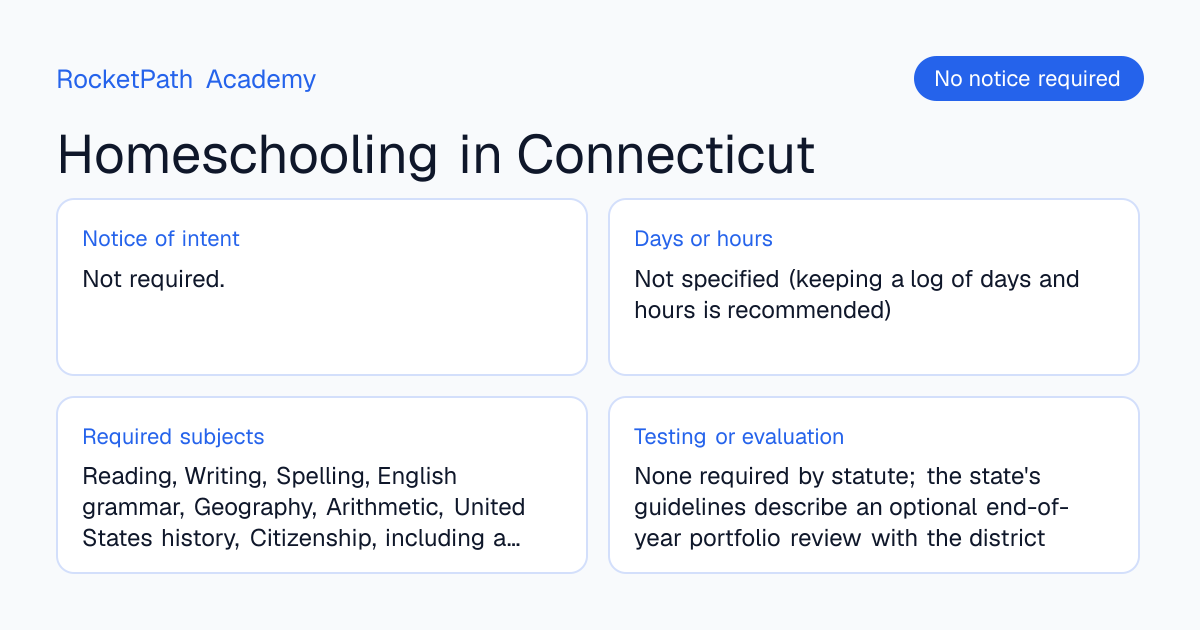
Requirements in Connecticut
Home instruction ("equivalent instruction") · Conn. Gen. Stat. § 10-184
Parents may teach their children at home if they can show the child is receiving equivalent instruction in the required subjects. The State Department of Education's guidelines (Circular Letter C-14, 1994) describe a Notice of Intent and an annual portfolio review; HSLDA treats these as optional, while many districts expect them.
- Notice
- Not required.
- Instruction time
- Not specified (keeping a log of days and hours is recommended).
- Required subjects
- Reading.
- Writing.
- Spelling.
- English grammar.
- Geography.
- Arithmetic.
- United States history.
- Citizenship, including a study of town, state, and federal governments.
- Records to keep
- A portfolio with samples of work in each required subject (needed if you take part in a portfolio review).
- Attendance log (recommended).
- Testing / evaluation
- None required by statute; the state's guidelines describe an optional end-of-year portfolio review with the district.
- Parent qualifications
- None.
What the notice must include
- Name of the teacher (usually the parent).
- Subjects to be taught.
- Days of instruction.
- How you will assess progress.
Checklist
- Withdraw your child from their current school in writing (if enrolled): before you start homeschooling.
- File a Notice of Intent with your superintendent (recommended, not required until 2028-29): within 10 days of starting, then each year.
- Keep a portfolio of work in each required subject: ongoing.
- Starting 2028-29: file the state intent to educate form with your school district: by October 1 each year (within 14 days of moving into a new district).
Leaving a public school
Until July 1, 2027, Connecticut sets no special procedure for withdrawing to homeschool; notify the school in writing. Starting with the 2027-28 school year (Public Act 26-37), you must appear in person at the school district office and sign a withdrawal form. Within two business days the superintendent runs a Department of Children and Families records check on every adult (18+) living with the child, and must tell you within five business days whether the withdrawal is effective. A withdrawal is blocked if any adult in the home is on the state child abuse and neglect registry or under an open DCF abuse or neglect investigation; the district must explain how to challenge the finding.
Common questions about homeschooling in Connecticut
- Do I have to notify anyone to homeschool in Connecticut?
- No. Connecticut doesn't require a notice of intent for this option. If your child is enrolled in a public school, withdraw them in writing first.
- What subjects do I have to teach in Connecticut?
- Connecticut requires: Reading; Writing; Spelling; English grammar; Geography; Arithmetic; United States history; Citizenship, including a study of town, state, and federal governments.
- How many days or hours of homeschool does Connecticut require?
- Not specified (keeping a log of days and hours is recommended).
- Are standardized tests or evaluations required in Connecticut?
- None required by statute; the state's guidelines describe an optional end-of-year portfolio review with the district.
- Do parents need a teaching certificate to homeschool in Connecticut?
- None.
- What records should I keep when homeschooling in Connecticut?
- A portfolio with samples of work in each required subject (needed if you take part in a portfolio review); Attendance log (recommended).
Worth double-checking
- Compulsory school age is 5 to 18. Parents of a 5- or 6-year-old may delay school by personally signing an option form at the district office each year.
- Public Act 26-37 was signed May 26, 2026. Its homeschool provisions phase in: the state must create the intent to educate and withdrawal forms by July 1, 2027; the in-person withdrawal and DCF records check apply from the 2027-28 school year; the annual intent to educate form (due October 1, with districts following up after November 1) applies from the 2028-29 school year. The law formally names homeschooling "parent-managed learning." We will update this page as the forms are released.
- The State Department of Education's older guidance memo says parents "must" file a Notice of Intent each year, while HSLDA says the guidelines are optional and not required by statute. Filing the notice is the low-risk choice and many districts expect it.
- We could not find a current State Department of Education homeschool page; the guidance memo linked above is from 2013-14 and notes that its attachments predate the age 5-18 attendance change.
Sources
- Conn. Gen. Stat. § 10-184 (Connecticut General Assembly, Chapter 168).(official)
- Public Act 26-37 (HB 5468), An Act Concerning the Provision of Parent-Managed Learning.(official)
- Connecticut State Department of Education: Information Concerning Educating Children at Home (memo).(official)
- HSLDA: How to comply with Connecticut's homeschool law.
- HSLDA: HB 5468 updates.
This is a plain-language summary to help you get organized, not legal advice. Laws and forms change, so confirm the details with your state or school district before you file.