How to homeschool in Hawaii
In Hawaii you give a notice of intent (Form 4140 or a short letter) to the principal of your local public school before you start, then turn in a yearly progress report. Standardized test scores are required in grades 3, 5, 8, and 10. You also keep a written record of your planned curriculum, which the school may ask to see.
Option 1: Home schooling (notice of intent)
The option most families use.
Home schooling (notice of intent) · HRS § 302A-1132; Haw. Admin. Rules §§ 8-12-13 to 8-12-19
A parent teaches their own child at home after giving the local public school principal a notice of intent. The parent is considered a qualified instructor. The family keeps a curriculum record, submits an annual progress report, and provides test scores in grades 3, 5, 8, and 10.
- Notice
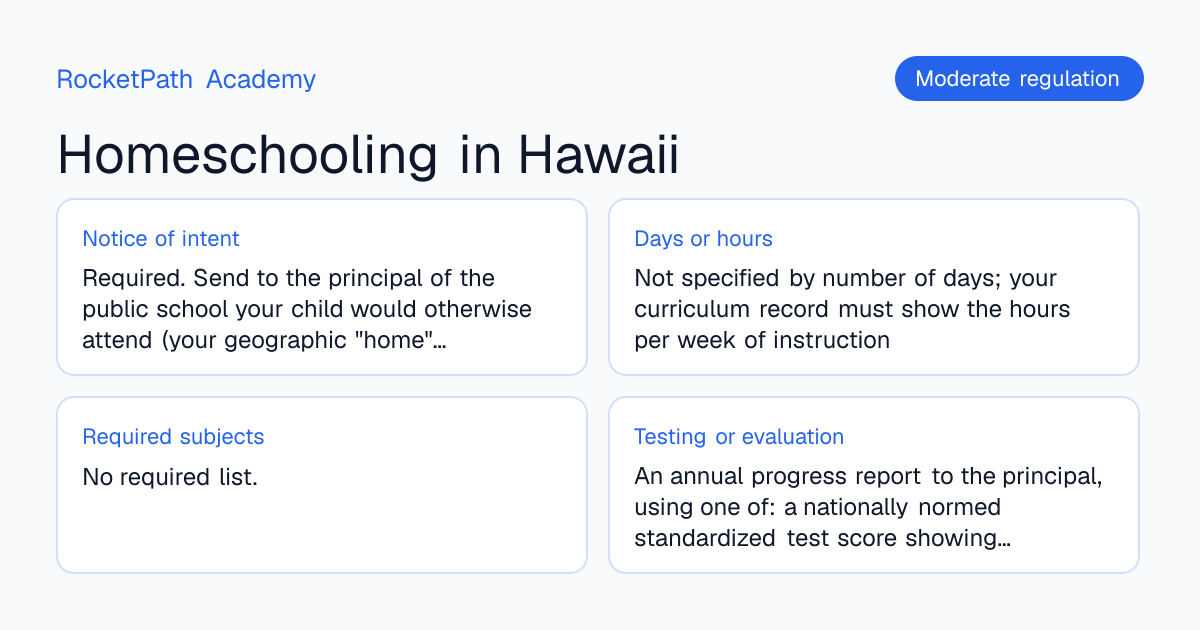
- Send to: the principal of the public school your child would otherwise attend (your geographic "home" school).
- When: before you begin home schooling.
- How often: once, as long as annual progress reports are submitted; send a new notice when your child would move to a different public school (e.g. elementary to middle, middle to high) or when you move.
- How: submit Form 4140 (complete Section B, Option 5) or a signed letter to the school; the principal and complex area superintendent acknowledge it and return a copy.
- Instruction time
- Not specified by number of days; your curriculum record must show the hours per week of instruction.
- Records to keep
- Record of the planned curriculum: program start and end dates.
- Hours per week of instruction.
- Subject areas covered.
- Method used to determine mastery.
- List of textbooks and materials in bibliographic format (author, title, publisher, date).
- Testing / evaluation
- An annual progress report to the principal, using one of: a nationally normed standardized test score showing grade-level achievement; standardized test progress equal to one grade level per year; a written evaluation by a Hawaii-certified teacher; or a parent's written evaluation describing progress in each subject with representative work samples and tests. Test scores are also required in grades 3, 5, 8, and 10 (free at the local public school, or private testing at your expense); in those years the test can serve as the annual report.
- Parent qualifications
- None; a parent teaching their own child is deemed a qualified instructor.
- Also
- If progress is inadequate, the principal meets with the parent to set an improvement plan; no recommendation to enroll in school or legal action may be made unless progress is inadequate for two consecutive semesters, and none before 3rd grade.
- Notify the principal (written or verbal) if you stop home schooling; the child must be enrolled in a public or licensed private school within five school days unless a new alternative program is presented.
Official form: Hawaii DOE homeschool page (links Form 4140, Exceptions to Compulsory Education)
What the notice must include
- Child's name.
- Child's address and telephone number.
- Child's birthdate.
- Child's grade level.
- Parent's signature.
Checklist
- Submit Form 4140 or a signed letter of intent to your local public school principal: before you begin home schooling.
- Keep a written record of your planned curriculum: ongoing.
- Submit the annual progress report to the principal: each year (the rules set no specific date; ask your school when it expects it).
- Provide standardized test scores: in grades 3, 5, 8, and 10.
- Send a new notice of intent to the new school's principal: when your child would change public schools (e.g. entering middle or high school) or you move.
- Notify the principal if home schooling ends: when you stop home schooling.
Option 2: Superintendent-approved alternative educational program (tutoring)
Superintendent-approved alternative educational program (tutoring) · Haw. Admin. Rules §§ 8-12-8 to 8-12-10
Instruction by someone other than the parent (for example, a tutor) under a plan approved by the superintendent or designee. Instructors must hold at least a bachelor's degree. The approval must be renewed every year.
- Notice
- Send to: the principal of your local public school (for the superintendent's or designee's approval).
- When: before the program begins; approval is required.
- How often: annually.
- How: Form 4140 plus a planned curriculum and proof of instructor qualifications.
- Instruction time
- Averaging approximately 3 hours per school day.
- Testing / evaluation
- Participation in the Statewide Testing Program grades (or comparable private testing), plus a narrative progress report and report card from the instructor submitted to the principal at the end of each school year.
- Parent qualifications
- Professional instructors must have at least a bachelor's degree from an accredited college or university.
Official form: Hawaii DOE homeschool page (links Form 4140 and HAR Chapter 12)
What the notice must include
- Form 4140.
- Planned curriculum: start and end dates, hours per week (about 3 hours per school day on average), subjects, method of determining mastery, and list of materials.
- Instructor names, addresses, phone numbers, other employment, and official transcripts showing at least a bachelor's degree.
Checklist
- Submit Form 4140, planned curriculum, and instructor transcripts for approval: before the program begins, and renew annually.
- Submit narrative progress report and report card to the principal: at the end of each school year.
Leaving a public school
To withdraw a public school student to homeschool, submit Form 4140 or a letter of intent to the child's designated public school; home schooling begins once the signed notice is submitted. The school may not require a birth certificate, proof of residency, or health records for this.
Common questions about homeschooling in Hawaii
- Do I have to notify anyone to homeschool in Hawaii?
- Yes (for home schooling (notice of intent), the option most families use). You send notice to the principal of the public school your child would otherwise attend (your geographic "home" school), before you begin home schooling. How often: once, as long as annual progress reports are submitted; send a new notice when your child would move to a different public school (e.g. elementary to middle, middle to high) or when you move. Submit Form 4140 (complete Section B, Option 5) or a signed letter to the school; the principal and complex area superintendent acknowledge it and return a copy.
- What subjects do I have to teach in Hawaii?
- Hawaii doesn't set a required subject list (for home schooling (notice of intent), the option most families use). Most families still cover reading, writing, math, science and social studies.
- How many days or hours of homeschool does Hawaii require?
- Not specified by number of days; your curriculum record must show the hours per week of instruction.
- Are standardized tests or evaluations required in Hawaii?
- An annual progress report to the principal, using one of: a nationally normed standardized test score showing grade-level achievement; standardized test progress equal to one grade level per year; a written evaluation by a Hawaii-certified teacher; or a parent's written evaluation describing progress in each subject with representative work samples and tests. Test scores are also required in grades 3, 5, 8, and 10 (free at the local public school, or private testing at your expense); in those years the test can serve as the annual report.
- Do parents need a teaching certificate to homeschool in Hawaii?
- None; a parent teaching their own child is deemed a qualified instructor.
- What records should I keep when homeschooling in Hawaii?
- Record of the planned curriculum: program start and end dates; Hours per week of instruction; Subject areas covered; Method used to determine mastery; List of textbooks and materials in bibliographic format (author, title, publisher, date).
Worth double-checking
- The rules require test scores in grade 10, but Hawaii public school students now take the state test in grade 11. Ask the Hawaii DOE homeschool office (808-351-5009) which grade applies to your child.
- Neither the rules nor the DOE page give a specific due date for the annual progress report; confirm the expected date with your local school.
- Homeschooled students do not earn public school credit or a public high school diploma for time homeschooled; a High School Equivalency credential is available through the community school for adults.
Sources
- Hawaii State Department of Education: Homeschool (updated 05/2026).(official)
- Hawaii Administrative Rules, Title 8, Chapter 12: Compulsory Attendance Exceptions (Board of Education).(official)
- Haw. Code R. § 8-12-13 Notification of intent to home school (Cornell LII).
This is a plain-language summary to help you get organized, not legal advice. Laws and forms change, so confirm the details with your state or school district before you file.