How to homeschool in West Virginia
In West Virginia you file a one-time notice of intent with your county superintendent when you start homeschooling (and again if you move counties). The person teaching needs a high school diploma or equivalent. Your child is assessed every year (a test, a portfolio review by a certified teacher, or another approved option), you keep the results for three years, and you send results to the county only in grades 3, 5, 8, and 11, by June 30.
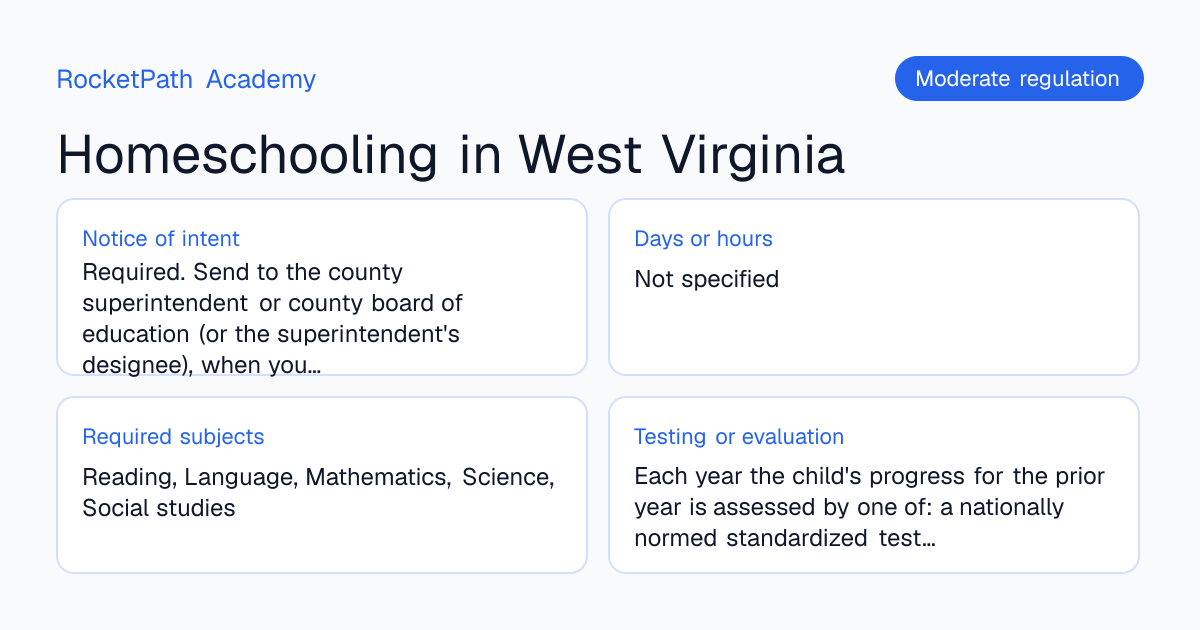
Option 1: Home instruction (notice of intent)
The option most families use.
Home instruction (notice of intent) · W. Va. Code § 18-8-1(c)(2)
The option most West Virginia homeschoolers use. You file a notice with the county, meet a basic education requirement, and do an annual assessment. There is no set school year length, no teacher certification requirement, and you choose your own curriculum.
- Notice
- Send to: the county superintendent or county board of education (or the superintendent's designee).
- When: when you begin home instruction; if your child is enrolled in public school, on or before the date home instruction begins.
- How often: once, plus a new notice if you move to a different county.
- How: a written notice of intent; many counties provide their own form.
- Instruction time
- Not specified.
- Required subjects
- Reading, Language, Mathematics, Science, Social studies.
- Records to keep
- A copy of each year's academic assessment, kept for at least three years.
- Proof of the instructor's high school diploma or equivalent.
- A copy of your notice of intent.
- Testing / evaluation
- Each year the child's progress for the prior year is assessed by one of: a nationally normed standardized test published or normed within the last 10 years (acceptable progress is a mean score in or above the 4th stanine, or improvement from the year before if below); the state testing program at a public school in your county; a portfolio review with a written narrative by a certified teacher; or another assessment agreed to by you and the county superintendent. Submit results to the county superintendent only for grades 3, 5, 8, and 11, by June 30 of the year the assessment was given. If progress isn't acceptable, start a remedial program; if it is still not acceptable the next year, more evidence of appropriate instruction is required.
- Parent qualifications
- The person providing instruction must present satisfactory evidence of a high school diploma or equivalent, or a post-secondary degree or certificate from a regionally accredited or state-authorized institution.
- Also
- Notify the county superintendent when home instruction ends for a child still of compulsory school age.
- If you move counties, notify the previous county superintendent and file a new notice of intent with the new county.
What the notice must include
- Name, address, and age of each compulsory-school-age child to be taught.
- An assurance that the child will receive instruction in reading, language, mathematics, science, and social studies.
Checklist
- File the notice of intent with the county superintendent, with proof of the instructor's diploma: on or before the first day of home instruction.
- Complete the annual academic assessment: each year.
- Send assessment results to the county superintendent: by June 30 in grades 3, 5, 8, and 11.
- Keep each year's assessment: for at least three years.
- File a new notice if you move counties, and notify the county when you stop homeschooling: as it happens.
Option 2: Learning pod or microschool
Learning pod or microschool · W. Va. Code § 18-8-1(n)
A child takes part in a learning pod (a voluntary group of parents) or a microschool (a tuition-based small school). The law says this is not the same as homeschooling, but the notice, instructor qualification, assessment, and recordkeeping rules mirror home instruction.
- Notice
- Send to: the county superintendent or county board of education.
- When: before participation begins, or on or before the enrollment date if the child is currently in public school.
- How often: once.
- How: a written notice.
- Required subjects
- Reading, Language, Mathematics, Science, Social studies.
- Records to keep
- Each year's academic assessment, kept for three years.
- Testing / evaluation
- Same options as home instruction. Results for grades 3, 5, 8, and 11 go to the county superintendent by June 30; a pod or microschool may submit a composite instead of individual results.
- Parent qualifications
- Same as home instruction: a high school diploma or equivalent, or a qualifying post-secondary degree or certificate.
What the notice must include
- Name, address, and age of each child.
- An assurance of instruction in reading, language, mathematics, science, and social studies.
Checklist
- File the notice with the county superintendent: before your child begins participating.
- Complete the annual assessment and send results in grades 3, 5, 8, and 11: each year; results due by June 30.
Option 3: County-approved home instruction
County-approved home instruction · W. Va. Code § 18-8-1(c)(1)
An older, less common route: instruction at home or another place approved by the county board, for the same length of time as the public school term, by a person the county superintendent and board judge qualified. The board must give written reasons if it denies the request.
- Notice
- Send to: the county board of education (approval request).
- When: before instruction begins.
- How: a written request for county board approval.
- Instruction time
- Equal to the public school instructional term.
- Parent qualifications
- A person the county superintendent and county board find qualified.
Checklist
- Request approval from the county board of education: before instruction begins.
Leaving a public school
If your child is enrolled in public school, give the county your notice of intent on or before the first day of home instruction. The county does not have to approve it; a superintendent can only stop home instruction through a circuit court order.
Common questions about homeschooling in West Virginia
- Do I have to notify anyone to homeschool in West Virginia?
- Yes (for home instruction (notice of intent), the option most families use). You send notice to the county superintendent or county board of education (or the superintendent's designee), when you begin home instruction; if your child is enrolled in public school, on or before the date home instruction begins. How often: once, plus a new notice if you move to a different county. A written notice of intent; many counties provide their own form.
- What subjects do I have to teach in West Virginia?
- West Virginia requires: Reading; Language; Mathematics; Science; Social studies.
- How many days or hours of homeschool does West Virginia require?
- Not specified.
- Are standardized tests or evaluations required in West Virginia?
- Each year the child's progress for the prior year is assessed by one of: a nationally normed standardized test published or normed within the last 10 years (acceptable progress is a mean score in or above the 4th stanine, or improvement from the year before if below); the state testing program at a public school in your county; a portfolio review with a written narrative by a certified teacher; or another assessment agreed to by you and the county superintendent. Submit results to the county superintendent only for grades 3, 5, 8, and 11, by June 30 of the year the assessment was given. If progress isn't acceptable, start a remedial program; if it is still not acceptable the next year, more evidence of appropriate instruction is required.
- Do parents need a teaching certificate to homeschool in West Virginia?
- The person providing instruction must present satisfactory evidence of a high school diploma or equivalent, or a post-secondary degree or certificate from a regionally accredited or state-authorized institution.
- What records should I keep when homeschooling in West Virginia?
- A copy of each year's academic assessment, kept for at least three years; Proof of the instructor's high school diploma or equivalent; A copy of your notice of intent.
Worth double-checking
- § 18-8-1 was amended in 2023 (HB 3408), 2024 (HB 5180), and 2025 (HB 2777). The summary reflects the current code text, but recent sessions have seen proposals to tighten homeschool rules, so check the code for any 2026 changes.
- The statute requires the instructor to present evidence of a diploma but does not say exactly when; most counties ask for a copy with the notice of intent.
- There is no single statewide notice form; use your county's form or a written letter with the required contents.
- Children attending a private school that elects to comply with W. Va. Code § 18-28 (§ 18-8-1(k)) are private school students, which is not covered here.
Sources
- W. Va. Code § 18-8-1, Exemptions from compulsory attendance (West Virginia Legislature).(official)
- WV Department of Education: Homeschool state code.(official)
- HSLDA: West Virginia.
This is a plain-language summary to help you get organized, not legal advice. Laws and forms change, so confirm the details with your state or school district before you file.