How to homeschool in Massachusetts
In Massachusetts you must get your homeschool plan approved in advance by your local school district (superintendent or school committee) before you start. Each district sets its own policy, but they typically look at your curriculum, materials, how much time you'll spend teaching, and how your child's progress will be evaluated. Don't pull your child from school until the plan is approved, or the child may be considered truant.
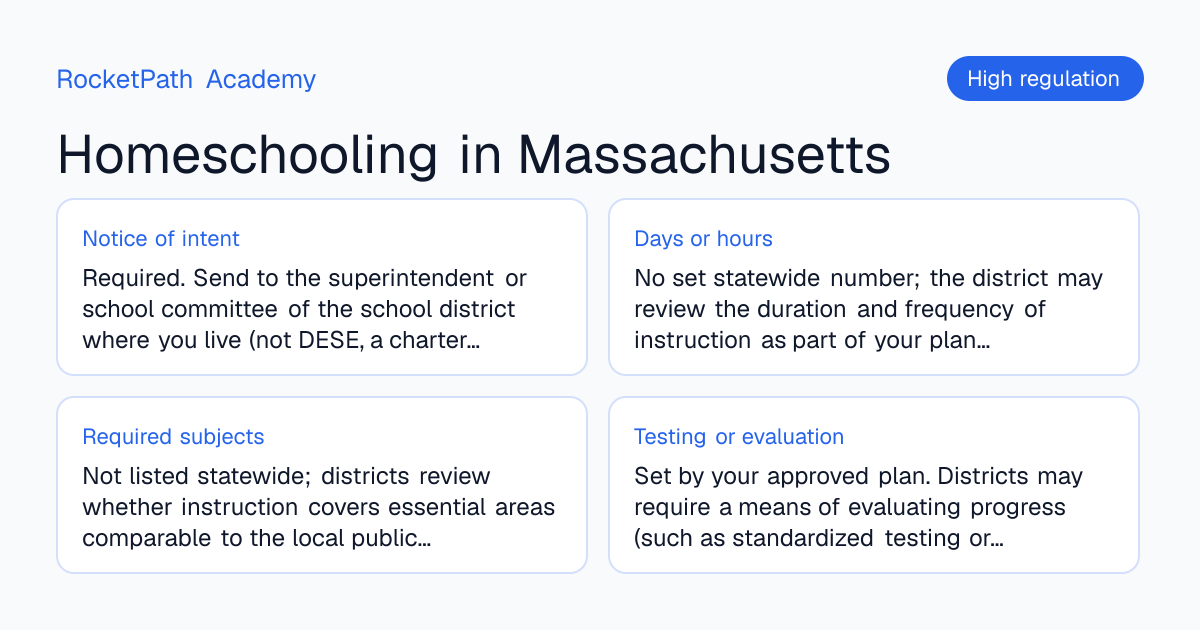
Requirements in Massachusetts
Home education plan approved by the local school district · Mass. G.L. c. 76, § 1
Children of compulsory school age (6-16) may be 'otherwise instructed in a manner approved in advance by the superintendent or the school committee.' You notify your resident district, receive its home schooling policy, and submit a proposed education plan; the district approves it, asks for changes, or disapproves it. The standard is whether your instruction equals the local public schools in thoroughness and efficiency.
- Notice
- Send to: the superintendent or school committee of the school district where you live (not DESE, a charter school, or a virtual school).
- When: Before you begin home schooling; approval must come first. Most districts ask for a new plan each school year.
- How often: annually in most districts (set by local policy).
- How: Written notice to the district, then a written education plan following the district's policy.
- Instruction time
- No set statewide number; the district may review the duration and frequency of instruction as part of your plan (public-school structured learning time rules do not apply).
- Required subjects
- Not listed statewide; districts review whether instruction covers essential areas comparable to the local public schools (district policies commonly list subjects such as reading, writing, English, math, science, history/social studies, health, and physical education).
- Records to keep
- Your approved plan and the district's approval letter.
- Whatever progress records your plan commits you to (work samples, progress reports, test results).
- Testing / evaluation
- Set by your approved plan. Districts may require a means of evaluating progress (such as standardized testing or progress reports, or an agreed alternative) but may not require home visits as a condition of approval.
- Parent qualifications
- No license required; the district may consider the parent's competency to teach as part of the plan.
- Also
- Home-schooled students keep the right to special education evaluation and services from the district.
- Districts decide whether home-schooled students may join district courses, programs, or athletics.
What the notice must include
- Parent's name and address and each child's name and age (district policies vary).
- Proposed curriculum and the subjects to be taught.
- Instructional materials and textbooks to be used.
- Number of hours or duration and frequency of instruction.
- Qualifications or competency of the parent(s) who will teach (no teaching license may be required).
- How your child's progress will be evaluated (for example standardized testing, progress reports, or another agreed method).
Checklist
- Send written notice to your district and request its home schooling policy: before withdrawing your child or starting home school.
- Submit your education plan (curriculum, materials, hours, evaluation method) and wait for written approval: before starting; most districts expect it before the school year begins.
- Carry out the evaluation or progress reporting in your approved plan: as your plan and district policy specify (often annually).
- Resubmit a plan for the next school year: each year, if your district's policy requires it.
Leaving a public school
Do not remove a child of compulsory school age from school until your district has approved your home education plan; DESE warns that doing so without an approved plan could make the child truant.
Common questions about homeschooling in Massachusetts
- Do I have to notify anyone to homeschool in Massachusetts?
- Yes. You send notice to the superintendent or school committee of the school district where you live (not DESE, a charter school, or a virtual school), before you begin home schooling; approval must come first. Most districts ask for a new plan each school year. How often: annually in most districts (set by local policy). Written notice to the district, then a written education plan following the district's policy.
- What subjects do I have to teach in Massachusetts?
- Massachusetts requires: Not listed statewide; districts review whether instruction covers essential areas comparable to the local public schools (district policies commonly list subjects such as reading, writing, English, math, science, history/social studies, health, and physical education).
- How many days or hours of homeschool does Massachusetts require?
- No set statewide number; the district may review the duration and frequency of instruction as part of your plan (public-school structured learning time rules do not apply).
- Are standardized tests or evaluations required in Massachusetts?
- Set by your approved plan. Districts may require a means of evaluating progress (such as standardized testing or progress reports, or an agreed alternative) but may not require home visits as a condition of approval.
- Do parents need a teaching certificate to homeschool in Massachusetts?
- No license required; the district may consider the parent's competency to teach as part of the plan.
- What records should I keep when homeschooling in Massachusetts?
- Your approved plan and the district's approval letter; Whatever progress records your plan commits you to (work samples, progress reports, test results).
Worth double-checking
- The details of what a plan must include come from case law (Care and Protection of Charles, 1987; Brunelle v. Lynn Public Schools, 1998, which bars required home visits) and each district's own policy, not from a statewide form. Get your district's policy before writing your plan.
- DESE does not approve plans or review district decisions; disputes go through the district (and, if needed, the courts).
- Districts must respond within a 'reasonable period'; no fixed number of days is set statewide, so submit well before you plan to start.
Sources
- Mass. G.L. c. 76, § 1 - School attendance (Massachusetts Legislature).(official)
- Massachusetts DESE - Home Schooling.(official)
This is a plain-language summary to help you get organized, not legal advice. Laws and forms change, so confirm the details with your state or school district before you file.