How to homeschool in Michigan
Michigan is one of the least regulated states for homeschooling. If you teach your own children at home in an organized program covering the required subjects, you don't need to notify anyone, test, or get approval. Registering with the state is optional and only needed if you want public school services such as special education or part-time classes.
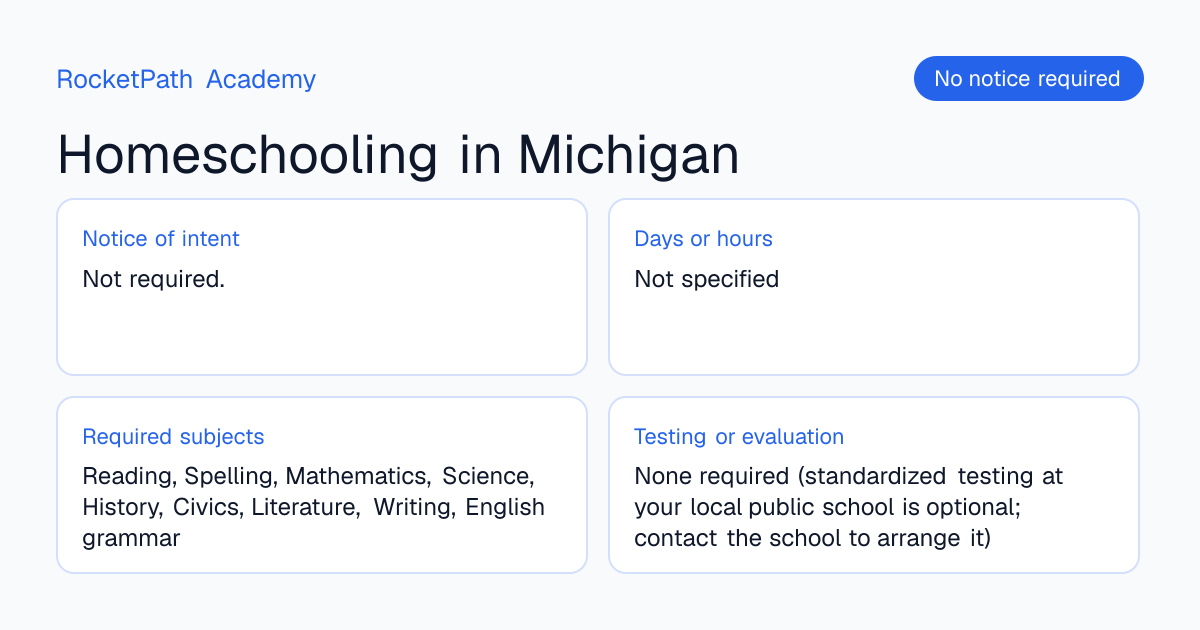
Option 1: Home education (exemption 3(f))
The option most families use.
Home education (exemption 3(f)) · MCL 380.1561(3)(f)
A parent or legal guardian educates their own child at the child's home in an organized educational program covering reading, spelling, math, science, history, civics, literature, writing, and English grammar. There is no notice, approval, or testing requirement, and the Michigan Department of Education plays no role. Only the parent or legal guardian qualifies; a grandparent, tutor, or neighbor teaching the child is not homeschooling under this exemption.
- Notice
- Not required.
- Instruction time
- Not specified.
- Required subjects
- Reading, Spelling, Mathematics, Science, History, Civics, Literature, Writing, English grammar.
- Records to keep
- None required by law; MDE notes parents are solely responsible for their own gradebooks, progress reports, transcripts, and diplomas, so keeping them is strongly recommended.
- Testing / evaluation
- None required (standardized testing at your local public school is optional; contact the school to arrange it).
- Parent qualifications
- Must be the child's parent or legal guardian; no other qualifications. (To register and be approved for public school services, MDE says the parent needs at least a bachelor's degree or must claim a religious objection to teacher certification.).
- Also
- All the required subjects must be taught at home; splitting core subjects with a public or private school does not count as homeschooling.
- Students enrolled in a public school academy or other public online school are public school students, not homeschoolers.
Checklist
- Notify your child's current school in writing that you are homeschooling (recommended by MDE, not required): when you withdraw your child.
- Teach an organized program covering all nine required subjects: ongoing.
- Optional: file the Homeschool Membership Report with MDE if you want public school services: each school year you want services.
Option 2: Home school operating as a nonpublic school (exemption 3(a))
Home school operating as a nonpublic school (exemption 3(a)) · MCL 380.1561(3)(a) and (4); Private, Denominational, and Parochial Schools Act (MCL 388.551 et seq.)
A home school can instead operate as a state-registered nonpublic school teaching subjects comparable to the local public schools. This option carries more requirements than exemption (f) and is used by relatively few families.
- Notice
- Send to: the Michigan Department of Education.
- How often: annually.
- How: Register the school with MDE through its nonpublic school reporting system.
- Instruction time
- Not specified for home-based nonpublic schools in the sources reviewed.
- Required subjects
- Subjects comparable to those taught in the local public schools for children of the same age and grade.
- Records to keep
- Attendance and academic records as a school.
- Testing / evaluation
- None required by the state.
- Parent qualifications
- Teacher must hold a teaching certificate, or (per MDE homeschool guidance) the parent needs at least a bachelor's degree or claims a sincerely held religious objection to teacher certification (People v. DeJonge, 1993).
Checklist
- Register your home as a nonpublic school with MDE: each school year (confirm the current deadline with MDE).
- Teach subjects comparable to the local public schools and keep school records: ongoing.
Leaving a public school
No notice is legally required, but MDE recommends notifying the child's current school of your intent to homeschool so the child isn't reported as truant.
Common questions about homeschooling in Michigan
- Do I have to notify anyone to homeschool in Michigan?
- No (for home education (exemption 3(f)), the option most families use). Michigan doesn't require a notice of intent for this option. If your child is enrolled in a public school, withdraw them in writing first.
- What subjects do I have to teach in Michigan?
- Michigan requires: Reading; Spelling; Mathematics; Science; History; Civics; Literature; Writing; English grammar.
- How many days or hours of homeschool does Michigan require?
- Not specified.
- Are standardized tests or evaluations required in Michigan?
- None required (standardized testing at your local public school is optional; contact the school to arrange it).
- Do parents need a teaching certificate to homeschool in Michigan?
- Must be the child's parent or legal guardian; no other qualifications. (To register and be approved for public school services, MDE says the parent needs at least a bachelor's degree or must claim a religious objection to teacher certification.).
- What records should I keep when homeschooling in Michigan?
- None required by law; MDE notes parents are solely responsible for their own gradebooks, progress reports, transcripts, and diplomas, so keeping them is strongly recommended.
Worth double-checking
- Michigan lawmakers and the Department of Education have publicly proposed requiring homeschool registration; no such bill had been enacted as of this check. Watch for changes.
- Compulsory attendance runs from age 6 to 18 for most children today (age 16 only for children who turned 11 before December 1, 2009).
- Details for the nonpublic-school option (exact registration deadline, teacher requirements) could not be fully confirmed from MDE's public pages; confirm with MDE's nonpublic schools office before using it.
Sources
- MCL 380.1561 - Compulsory attendance (Michigan Legislature).(official)
- Michigan Department of Education - Homeschooling in Michigan (PDF).(official)
- Michigan Department of Education - Exemption (f) Home School.(official)
- HSLDA - How to Comply with Michigan's Homeschool Law.
This is a plain-language summary to help you get organized, not legal advice. Laws and forms change, so confirm the details with your state or school district before you file.