How to homeschool in Pennsylvania
Pennsylvania is one of the more involved states. Each year you file a notarized affidavit (or unsworn declaration) with your school district superintendent by August 1, with an outline of learning objectives and health records. During the year you keep a portfolio. A qualified evaluator then reviews it and interviews your child, and you send the evaluator's certification to the superintendent by June 30. Children also take standardized tests in grades 3, 5 and 8.
Option 1: Home education program
The option most families use.
Home education program · 24 P.S. § 13-1327.1
A parent or guardian with a high school diploma or equivalent supervises the child's education at home. You file a yearly affidavit, keep a portfolio, and submit an evaluator's certification each June. This is the option most Pennsylvania homeschoolers use.
- Notice
- Send to: the superintendent of your school district of residence.
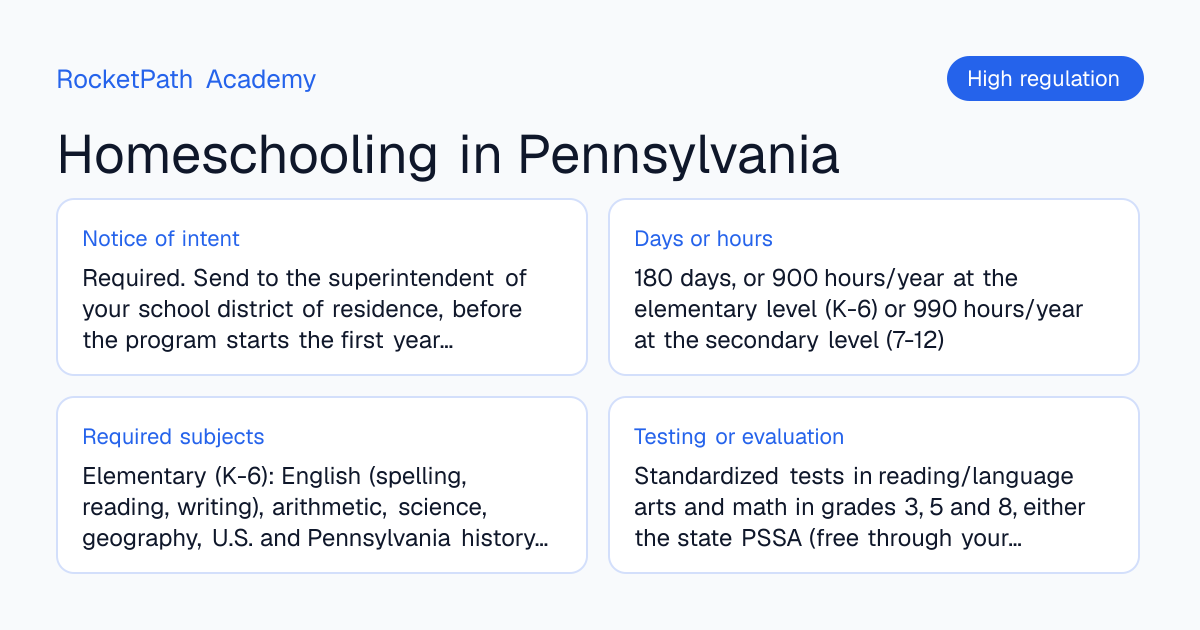
- When: before the program starts the first year (any time of year), then by August 1 each following year.
- How often: annually.
- How: notarized affidavit, or an unsworn declaration signed under penalty of perjury, mailed or delivered with its attachments.
- Instruction time
- 180 days, or 900 hours/year at the elementary level (K-6) or 990 hours/year at the secondary level (7-12).
- Required subjects
- Elementary (K-6): English (spelling, reading, writing), arithmetic, science, geography, U.S. and Pennsylvania history, civics, safety education (including fire prevention), health and physiology, physical education, music, art.
- Secondary (7-12): English (language, literature, speech, composition), science, geography, social studies (civics, world history, U.S. and Pennsylvania history), mathematics (general math, algebra, geometry), art, music, physical education, health, safety education (including fire prevention).
- For a state-recognized diploma, grades 9-12 must include at least 4 years of English, 3 of math, 3 of science, 3 of social studies, and 2 of arts and humanities.
- Records to keep
- Portfolio: a log made at the time of instruction listing reading materials by title.
- Portfolio: samples of writings, worksheets, workbooks, or creative materials.
- Portfolio: standardized test results for grades 3, 5 and 8.
- Copy of each year's affidavit and the evaluator's certification.
- Testing / evaluation
- Standardized tests in reading/language arts and math in grades 3, 5 and 8, either the state PSSA (free through your district) or an approved nationally normed test. Every year, a qualified evaluator reviews the portfolio and interviews the child and certifies whether an appropriate education is occurring; the parent pays the evaluator.
- Parent qualifications
- The supervisor must have a high school diploma or its equivalent. The supervisor and spouse may not act as the evaluator. Evaluators must be a licensed clinical or school psychologist, a PA-certified teacher with 2 years of grading experience at the level evaluated, a nonpublic school teacher or administrator with 2 years of PA teaching experience in the last 10 years, or another person approved in advance by the superintendent.
- Also
- Compulsory age is 6 to 18. Once a child is enrolled in public kindergarten or above, or in any school for first grade or above, an affidavit and evaluation are due every year regardless of age.
- If the superintendent has a reasonable belief that an appropriate education is not occurring, they may require an evaluation within 30 days by certified letter; a hearing can follow.
- The school district must lend curriculum materials on request and must allow homeschoolers to participate in cocurricular activities, CTE programs, and academic courses (up to at least 25% of the school day).
Official form: PA Department of Education sample affidavits and unsworn declarations (elementary and secondary)
What the notice must include
- Name of the supervisor of the home education program.
- Name and age of each child.
- Address and telephone number of the home education program site.
- Statement that the required subjects will be taught in English.
- Outline of proposed educational objectives by subject area.
- Evidence of immunization (or a medical, religious, or moral/ethical exemption).
- Evidence of required health and medical services (screenings, physical and dental exams) for the child's age or grade.
- Assurance that the program will comply with the home education law.
- Certification that the supervisor, all adults living in the home, and anyone with legal custody have not been convicted of the offenses listed in 24 P.S. § 1-111(e) in the past five years.
- For a child identified as needing special education: written approval of the program by a certified special education teacher or a licensed clinical or certified school psychologist.
Checklist
- File notarized affidavit (or unsworn declaration) with attachments: before starting the first year; by August 1 each year after.
- Submit immunization and health/dental exam records with the affidavit: with the affidavit each year.
- Keep a contemporaneous log and work samples for the portfolio: ongoing.
- Standardized test (PSSA or approved national test): in grades 3, 5 and 8.
- Portfolio review and interview with a qualified evaluator: each spring, before June 30.
- Submit the evaluator's certification to the superintendent: by June 30 each year.
Option 2: Private tutor
Private tutor · 24 P.S. § 13-1327(a); 22 Pa. Code § 11.31
A Pennsylvania-certified teacher (including a parent who holds PA certification) provides most of the instruction to one family's children. No affidavit or annual evaluation is filed; instead the tutor registers with the district and the parent gives a written assurance that the instructional requirements are met.
- Notice
- Send to: the superintendent of the school district of residence.
- When: when tutoring begins.
- How: tutor files a copy of their PA teaching certificate and criminal history record and reports the names and residences of the children tutored; parent provides a written assurance that the instructional requirements are met.
- Instruction time
- 180 days, or 900 hours/year (K-6) or 990 hours/year (7-12).
- Required subjects
- Elementary (K-6): English (spelling, reading, writing), arithmetic, geography, U.S. and Pennsylvania history, science, civics, safety education (including fire prevention), health (including physical education and physiology), music, art.
- Secondary (7-12): art, English, health, mathematics, music, physical education, science, social studies (civics, world history, U.S. and Pennsylvania history).
- Records to keep
- Portfolio-like documentation of instruction and progress, in case the superintendent investigates a complaint.
- Testing / evaluation
- None required by statute; the superintendent may request evidence of progress and instruction time if there is a complaint.
- Parent qualifications
- Tutor must hold a valid Pennsylvania teaching certificate and pass required background checks.
- Also
- Tutor must notify the district when tutoring ends and report any child absent 3 days without lawful excuse.
- There is no direct path to a state-recognized diploma through private tutoring.
What the notice must include
- Tutor's valid Pennsylvania teaching certificate.
- Tutor's required criminal history record.
- Names and residences of the children being tutored.
- Parent's written assurance that instruction meets the required subjects and time.
Checklist
- Tutor files certificate, background check, and student list with the superintendent: when tutoring begins.
- Give the superintendent a written assurance that instructional requirements are met: when tutoring begins.
- Keep records of instruction days/hours and student work: ongoing.
Option 3: Church or religious day school
Church or religious day school · 24 P.S. § 13-1327(b)
Attendance at a day school operated by a bona fide church or other religious body that provides at least 180 days or 900/990 hours of instruction satisfies compulsory attendance. Some families use a church-run school that serves only their household.
- Notice
- Not required.
- Instruction time
- 180 days, or 900 hours/year (elementary) or 990 hours/year (secondary).
Checklist
- Confirm the school's filing and reporting obligations with the Department of Education before relying on this option: before withdrawing from your current school.
Leaving a public school
A home education program legally exists only once the affidavit and attachments are submitted to the superintendent; no instruction time counts before that. File the affidavit with your district of residence before you stop sending your child to school.
Common questions about homeschooling in Pennsylvania
- Do I have to notify anyone to homeschool in Pennsylvania?
- Yes (for home education program, the option most families use). You send notice to the superintendent of your school district of residence, before the program starts the first year (any time of year), then by August 1 each following year. How often: annually. Notarized affidavit, or an unsworn declaration signed under penalty of perjury, mailed or delivered with its attachments.
- What subjects do I have to teach in Pennsylvania?
- Pennsylvania requires: Elementary (K-6): English (spelling, reading, writing), arithmetic, science, geography, U.S. and Pennsylvania history, civics, safety education (including fire prevention), health and physiology, physical education, music, art; Secondary (7-12): English (language, literature, speech, composition), science, geography, social studies (civics, world history, U.S. and Pennsylvania history), mathematics (general math, algebra, geometry), art, music, physical education, health, safety education (including fire prevention); For a state-recognized diploma, grades 9-12 must include at least 4 years of English, 3 of math, 3 of science, 3 of social studies, and 2 of arts and humanities.
- How many days or hours of homeschool does Pennsylvania require?
- 180 days, or 900 hours/year at the elementary level (K-6) or 990 hours/year at the secondary level (7-12).
- Are standardized tests or evaluations required in Pennsylvania?
- Standardized tests in reading/language arts and math in grades 3, 5 and 8, either the state PSSA (free through your district) or an approved nationally normed test. Every year, a qualified evaluator reviews the portfolio and interviews the child and certifies whether an appropriate education is occurring; the parent pays the evaluator.
- Do parents need a teaching certificate to homeschool in Pennsylvania?
- The supervisor must have a high school diploma or its equivalent. The supervisor and spouse may not act as the evaluator. Evaluators must be a licensed clinical or school psychologist, a PA-certified teacher with 2 years of grading experience at the level evaluated, a nonpublic school teacher or administrator with 2 years of PA teaching experience in the last 10 years, or another person approved in advance by the superintendent.
- What records should I keep when homeschooling in Pennsylvania?
- Portfolio: a log made at the time of instruction listing reading materials by title; Portfolio: samples of writings, worksheets, workbooks, or creative materials; Portfolio: standardized test results for grades 3, 5 and 8; Copy of each year's affidavit and the evaluator's certification.
Worth double-checking
- Many districts have their own affidavit forms and board policies; any form is acceptable if it includes everything the law requires.
- The religious day school option is summarized only at a high level here. Its filing requirements with the Pennsylvania Department of Education were not confirmed for this summary, so check with PDE before relying on it.
- PDE's guide (May 2026) also lists health education, physical education and electives under state graduation standards for a home education diploma; the statute itself lists the 4/3/3/3/2 minimum shown above.
Sources
- PA Department of Education: Home Education and Private Tutoring.(official)
- PA Department of Education: Home Education and Private Tutoring Guide (revised May 2026, PDF).(official)
- PA Department of Education: Home Education Program Basic Education Circular (24 P.S. § 13-1327.1).(official)
This is a plain-language summary to help you get organized, not legal advice. Laws and forms change, so confirm the details with your state or school district before you file.